AI adoption in the workplace appears to be accelerating, with employees increasingly using, experimenting with, and relying on it to get work done. On the surface, the story looks positive.
According to a survey conducted by The Harris Poll on behalf of INTOO among over 1,100 full/part time employees, more than half (52%) say they are experts at using AI for work-related tasks. Nearly two-thirds (63%) believe their AI knowledge for work-related tasks makes them more valuable employees.
But beneath that confidence is a much more complex and, frankly, concerning reality.
High Confidence in AI Use Does Not Come With Clear Understanding
Despite high levels of self-reported expertise, some employees are operating without clear guidance:
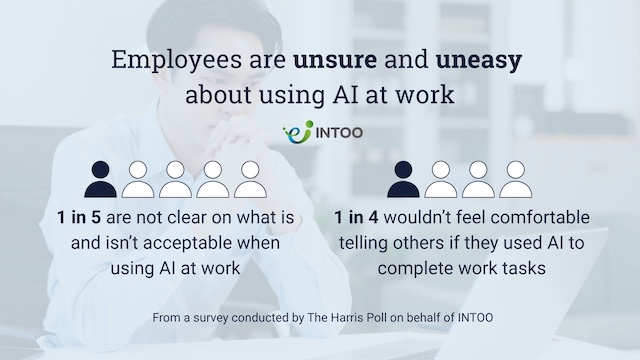
- 1 in 5 employees (20%) say they are not clear on what is and isn’t acceptable when using AI at work
- 1 in 4 employees (25%) would not feel comfortable telling others if they used AI to complete a task
This creates a fundamental tension. Employees are using AI, but many are unsure about the boundaries and hesitant to be transparent.
That’s not structured adoption. That’s informal, self-directed experimentation.
And in many organizations, it’s happening quietly.
“Silent AI Usage” in the Workplace
One of the most revealing insights is not just that employees are using AI, but how they’re using it.
A quarter of employees (25%) wouldn’t feel comfortable telling others within their organization if they used AI to complete a work task. That suggests AI use is, in some environments, still perceived as risky, questionable, or even stigmatized.
When employees don’t feel comfortable sharing how work gets done, organizations can lose visibility into:
- How AI is actually being used
- Where productivity gains are happening
- Where risks may be emerging
Instead of institutional learning, companies get fragmented and individual experimentation.
The Cultural Barrier to AI Adoption: Fear of Asking for Help
Another data point adds an important layer to this story:
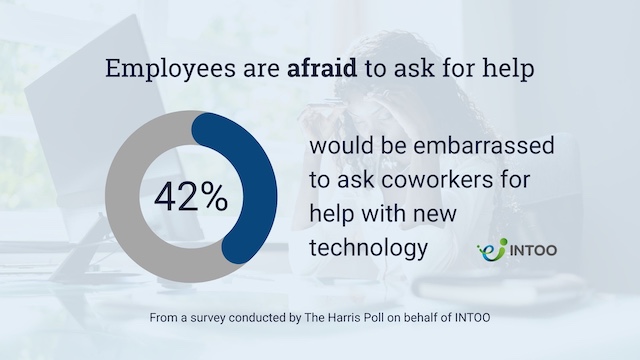
- 42% of employees say it would be embarrassing to ask coworkers for help using new technology
This is not a technical barrier. It’s a cultural one.
If over 40% of the workforce feels uncomfortable asking for help, then learning doesn’t happen out loud. It happens in isolation.
Employees rely on trial and error. They piece together knowledge from external sources. They avoid exposing gaps.
The result is slower, less consistent adoption and missed opportunities for company-wide skill-building.
A Surprising Generational Dynamic
There’s a common assumption that younger employees are leading the charge on AI adoption. The data partially supports this:
- 63% of employees aged 18–34 consider themselves AI experts for work-related tasks (compared to 39% of those aged 45+)
But there’s a twist.
This same group is also the most likely to feel embarrassed asking for help.
In other words, the cohort expected to lead AI adoption is often navigating it quietly, without support or open dialogue.
This combination—high confidence paired with embarrassment over asking for help—could increase the likelihood of overconfidence, inconsistent usage, hidden mistakes, and burnout. It can also make it harder for organizations to enforce consistent adherence to internal AI policies, assuming such policies are clearly defined and in place at all.
AI Job Security Fears Are Real, But Not Universal
Concerns about AI replacing jobs are real, but not evenly distributed:
- 34% of employees are worried they’ll lose their job to AI in the next two years
- 59% are not worried
Interestingly, concern decreases with age:
- 18–34: 42% worried
- 35–44: 36%
- 45–54: 33%
- 55+: 19%
Younger employees—who are most likely to consider themselves experts at using AI for work-related tasks—are also more likely to be concerned about its potential impact on their job security than those aged 55+ (19%). This suggests a dual reality: AI can be seen as both an opportunity and a threat.
This matters because fear influences behavior. Employees who feel at risk may be more likely to experiment privately, rather than openly, as they try to keep up.
What This Really Signals: A Culture Gap, Not a Skills Gap
Taken together, these findings point to a clear conclusion:
The biggest barrier to effective AI adoption isn’t capability. It’s culture.
Many employees are:
- confident in their ability to use AI
- actively integrating it into their work
But some are:
- unclear on guidelines
- uncomfortable being transparent or asking for help
That combination creates an environment where AI use can be widespread, but uneven, opaque, and difficult to manage.
The Risk of Unstructured AI Adoption in Organizations
Without addressing this gap, organizations face several risks:
Inconsistent usage
Different employees apply AI in different ways, with no shared standards.
Hidden risk exposure
Unclear policies increase the chance of misuse, especially around sensitive data or decision-making.
Missed learning loops
When employees don’t share how they’re using AI, best practices don’t spread.
Overstated expertise
Self-reported confidence may not reflect actual proficiency, especially without peer validation or collaboration.
What Needs to Change
If organizations want to fully realize the value of AI, they need to move beyond tool deployment and focus on environment design.
Three shifts matter most:
- Clarity over ambiguity
Employees need clear, practical guidance on what is acceptable. Not long policy documents, but real examples of how AI should and should not be used. - Transparency over secrecy
Leaders should normalize AI usage by talking about it openly. When leaders model transparency, employees are more likely to follow. - Psychological safety over silent learning
Organizations need to make it safe to ask questions, admit uncertainty, and share how work gets done.
Because right now, a large portion of AI adoption is happening behind closed doors.
The Bottom Line
AI is already embedded in how work gets done.
Employees are using it. They believe it makes them better employees. They see it as part of their value.
But some are navigating it without clear rules, without open conversation, and without support.
The organizations that succeed in this next phase won’t just be the ones that adopt AI tools.
They’ll be the ones that build cultures where people can use those tools openly, confidently, and collectively.
Survey Method:
This survey was conducted online within the United States by The Harris Poll on behalf of INTOO from March 31 – April 2, 2026 among 1,158 full/part time employed adults ages 18 and older. The sampling precision of Harris online polls is measured by using a Bayesian credible interval. For this study, the sample data is accurate to within +/- 3.6 percentage points using a 95% confidence level.
For complete survey methodology, including weighting variables and subgroup sample sizes, please contact us.media@intoo.com.
Sarina Basch is VP of Marketing at INTOO, where she leads research on evolving workforce trends. She has led multiple high-impact studies—frequently cited by top-tier media—on layoffs, careers, and workplace innovation, helping inform how business leaders and HR executives navigate today’s employee experience.