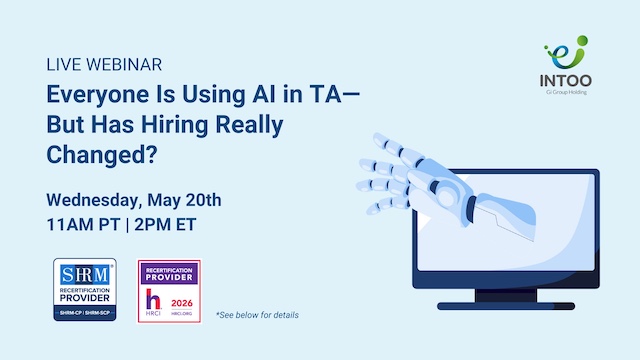
REGISTER NOW: Everyone Is Using AI in TA—But Has Hiring Really Changed?

A young Black woman leads her team in a project meeting

By

Robyn Kern

Categories

New research reveals a surprising gap between AI adoption and real impact in hiring. According to the latest study from ICIMS: 

  • 69% of organizations are using AI in TA—but usage is heavily concentrated in just a few areas 
  • AI is still primarily used for efficiency, not decision-making 
  • And less than half of companies regularly audit AI for bias 

So what’s really going on? 

In this session, we’ll break down where AI is actually being used across the hiring funnel—from sourcing to screening to interviewing—and where adoption drops off. More importantly, we’ll use the data to spark a candid discussion about what’s working, what’s not, and why. 

The organizations that get this right won’t just adopt AI—they’ll understand where it creates real value, where it introduces risk, and where human judgment still matters most.

Can’t join live? Register anyway and get the recording.

Date: Wednesday, May 20th
Time: 11 AM PT / 2 PM ET

In this 1-hour session, you will walk away with:

  1. Insight into how peers are actually using AI today
  2. A clear understanding of what’s real vs. overstated in AI adoption
  3. A sharper point of view on where AI should—and shouldn’t—be applied
  4. The right questions to ask before expanding AI in your hiring process

HR Certification Institute’s® (www.HRCI.org) official seal confirms that INTOO meets the criteria for pre-approved recertification credit(s) for any of HRCI’s eight credentials, including SPHR® and PHR®. This program has been approved for 1 HR (General) recertification credit hour toward aPHR™, aPHRi™, PHR®, PHRca®, SPHR®, GPHR®, PHRi™, and SPHRi™ recertification through the HR Certification Institute. This program is approved for 1 SHRM PDC.
SHRM Recertification Provider - SHRM-CP | SHRM-SCP
HRCI 2026 Recertification Provider

Trent Cotton, experienced HR leader and AI expert

iCIMS | Head of Talent Acquisition Insights & Analyst Relations

Trent Cotton is the Head of Talent Insights and Analyst Relations at iCIMS, a leading recruitment software provider, where he empowers global organizations with data-driven strategies to hire smarter and faster. With over 20 years of experience as an HR and Talent executive, Trent is known for translating complex workforce trends into clear, actionable insights that drive business results. 

He is the author of High Performance Recruiting and Sprint Recruiting, providing practical frameworks for transforming recruiting into a high-impact function. Passionate about bridging data with human decision-making, Trent continues to challenge traditional recruiting models and champion innovative approaches that meet the demands of today’s talent economy.

Trent Cotton
Robyn Kern

Robyn Kern is a seasoned business writer who has written in the HR, education, technology, and nonprofit spaces. She writes about topics including outplacement, layoffs, career development, internal mobility, candidate experience, succession planning, talent acquisition, and more, with the goal of surfacing workforce trends and educating the HR community on these key topics. Her work has been featured on hrforhr.org and trainingindustry.com.

Learn how to effectively build and transition your workforce.

Latest Posts

The Hidden Culture Issue Slowing AI Adoption

AI adoption in the workplace appears to be accelerating, with employees increasingly using, experimenting with, and relying on it to get work done. On the surface, the story looks positive. According to a survey conducted by The Harris Poll on behalf of INTOO among...

Sample Layoff Letter (With a Template)

Letting an employee go is difficult for all parties involved, and there are right ways and wrong ways to lay an employee off. The process requires a fine balance of legal compliance and human compassion. After all, from an employee’s point of view, being laid off is...

Reducing Downtime and Productivity Loss During Manufacturing Layoffs

Layoffs are expensive not only because of severance and legal fees but also because of lost production, reduced product quality, and the absence of skilled workers resulting from the workforce changes. Most manufacturing leaders understand this in theory, but few...

Beyond the Hype: How HR Is Really Using AI Today

AI is everywhere right now, bringing new tools, bold promises, and mounting pressure to “do something” quickly. But for HR leaders, the real challenge isn’t the technology itself. It’s deciding where AI actually helps, where human judgment can’t be replaced, and how...

How Does Outplacement Reduce Risk During Manufacturing Layoffs?

Manufacturing layoffs are among the highest-stakes workforce decisions a company can make. The ripple effects on operations, safety, employee morale, community relationships, and legal exposure can persist well beyond when the last notification letter goes out.  Yet...

Employee Accountability: Driving Ownership, Performance, and Trust

Think about the last time a project missed its deadline, a commitment slipped through the cracks, or a team member quietly checked out. More often than not, accountability—or lack thereof—was somewhere in the equation.  Employee accountability is the invisible force...

How to Lay Off Employees

Notifying employees of their layoff or termination is considered to be one of the most difficult tasks in business. Not only is the process riddled with potential legal landmines, but delivering what is often life-changing news to a colleague unearths feelings of...

How to Grow as a Leader in the Workplace

Good leadership is crucial in the modern, future-focused, dynamic business landscape. Leaders are not born; they are made through continuous growth, learning, and adaptation. Effective leadership is not a static trait but a constant growth, learning, and adaptation...