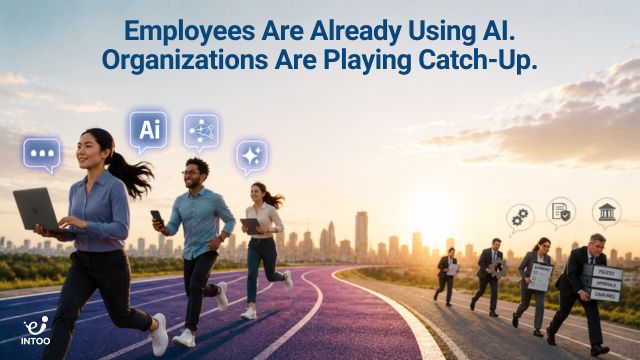
Artificial intelligence has become a fixture in the workplace. But according to new data from INTOO/Harris Poll, the story of AI adoption is not unfolding the way most workplace technologies have in the past.
Traditionally, the introduction of new technologies follows a familiar path: organizations invest in the tools, establish policies and processes, and employees gradually adopt them.
AI is turning that model on its head.
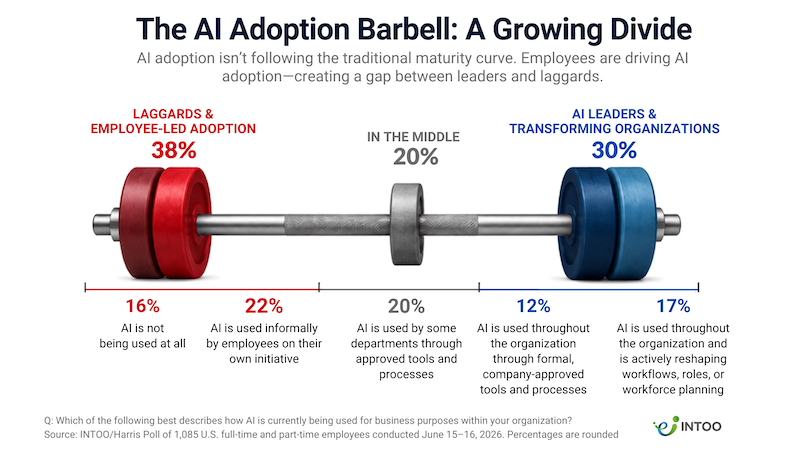
Over two in five full/part/time employees (22%) say AI is being used by individual workers for business purposes on their own initiative, without formal company-approved tools or processes. By comparison, only 12% report that AI is being used consistently across their organization through formal company-approved tools and processes. In other words, employees are not waiting for their organizations to build AI adoption strategies. They are bringing AI into their work on their own.
The findings suggest that AI adoption is being driven from the bottom up rather than the top down—a significant shift from how workplace technology has traditionally spread.
Workforce Adoption Is Outpacing Organizational Readiness
Nearly three-quarters (72%) of employees report that AI is being used for business purposes within their organization in some capacity.
Yet the nature of that adoption varies considerably:
- 22% say AI is being used informally by employees on their own initiative, but not through any formal company-approved tools or processes.
- 20% report AI is being used by some departments through approved tools and processes, but not consistently across the organization.
- 12% say AI is used throughout the company through formal company-approved tools and processes, but not consistently across the organization.
- 17% say AI is being used throughout the organization and is actively reshaping workflows, roles, or workforce planning.
Additionally:
- 16% report that AI is not being used at all.
- 9% are not sure if or how AI is used within their organization.
- 3% say none of these scenarios apply.
When approached from another angle, the findings suggest organizations are increasingly falling into one of two camps.
On one side are organizations that have yet to formalize AI adoption:
- 16% report no AI use.
- 22% report employee-led AI use without organizational programs.
Together, these groups represent 38% of workplaces.
On the other side are organizations where AI has moved beyond experimentation:
- 12% have organization-wide AI programs.
- 17% report AI is actively reshaping workflows and workforce planning.
Together, these more advanced organizations account for 30% of workplaces.
Meanwhile, only 20% sit in the middle with department-level adoption.
The distribution tells an important story. AI adoption isn’t following the traditional technology maturity curve, which makes best practices for adopting AI in organizations increasingly important to define. Instead of organizations leading adoption, employees are—and in the process, a gap is emerging between companies that are embracing AI strategically and those that are still relying on individual experimentation.
Employees may be finding ways to use AI to improve productivity, generate ideas, create content, conduct research, and streamline tasks—often before their employers have established formal AI adoption strategies, governance frameworks, or training programs.
For business leaders, this creates both opportunity and risk. The opportunity is that employees are already embracing the technology. The risk is that many organizations may struggle to provide the guidance needed to ensure AI is used effectively, securely, and consistently.
Employees Are More Excited Than Fearful About AI Adoption
Despite concerns about AI disrupting work, employee sentiment is largely positive.
When asked how they feel about using AI in their jobs:
- 34% say they are curious to learn more.
- 34% say they are excited about AI’s potential.
- 31% say they are confident using AI tools.
By contrast:
- 20% worry AI could make their job obsolete.
- 20% want to advance their use of AI but don’t know where to start.
- 20% are concerned about making mistakes when using AI.
- 10% say they are intimidated by AI tools.
The findings suggest that the workforce is not resisting AI. If anything, employees appear eager to engage with it. The bigger challenge may be helping them use it more effectively.
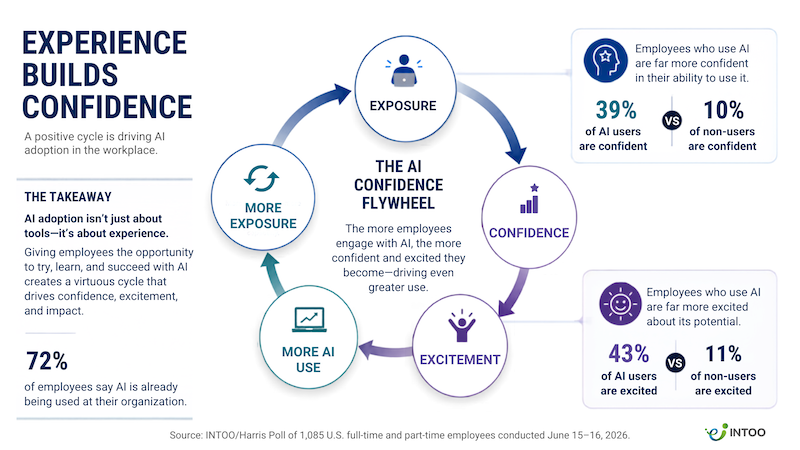
Experience With AI Builds Confidence
One of the clearest patterns in the data is the relation between AI exposure and employee attitudes.
Employees working in organizations that use AI are significantly more likely to feel positive about the technology:
- 43% are excited about AI’s potential, compared to just 11% among employees in organizations that do not use AI.
- 39% feel confident using AI tools, compared with 10% among those in organizations that do not use AI.
- 38% are curious to learn more, compared with 22% in organizations that do not use AI.
Rather than increasing fear, exposure appears to increase confidence and enthusiasm.
This finding challenges a common assumption that employees will resist AI adoption. In practice, the opposite appears to be true: people who work alongside AI are more likely to see its value and feel comfortable using it.
Job Loss Concerns Remain, Regardless of AI Adoption
Interestingly, concerns about job displacement remain consistent regardless of whether employees work in organizations that use AI.
Among employees at organizations that use AI, 21% worry that AI could make their jobs obsolete. Among employees in organizations that are not using AI, 19% express the same concern.
This suggests that fears about AI may be driven less by firsthand workplace experience and more by broader public narratives about automation and the future of work. These perceptions must be addressed as part of strategic AI adoption efforts.
As organizations expand AI adoption, effective communication will be critical. Employees need transparency about how AI will affect roles, workflows, and career paths.
The Biggest Opportunity Is Helping Employees Use AI Well
Perhaps the most actionable finding is that employees want support.
One in five employees says they are interested in advancing their use of AI but don’t know where to start. Another 20% worry about making mistakes, such as sharing sensitive information or relying on inaccurate outputs.
Taken together, the data suggests that preparing for AI adoption and convincing employees to embrace AI are no longer primary challenges facing organizations.
Employees are already there.
Instead, companies must focus on providing the structure employees seek: approved tools, practical training, clear policies, and guidance on responsible use.
The Bottom Line on AI Adoption in the Workplace
The AI conversation has moved beyond whether employees will use the technology.
Many already are.
What makes this moment unique is that AI adoption is being driven by employees rather than employers. Workers are experimenting, learning, and integrating AI into their daily work before many organizations have established formal company-wide approaches.
For business leaders, that reality changes the challenge entirely. The question is no longer whether AI will enter the workplace. It already has.
The question is whether organizations can move quickly enough to support a workforce that has already begun embracing it.
Survey Methodology
This survey was conducted online within the United States by The Harris Poll on behalf of INTOO from June 15 – 16, 2026 among 1,085 full or part time employed adults ages 18 and older. The sampling precision of Harris online polls is measured by using a Bayesian credible interval. For this study, the sample data is accurate to within +/- 3.5 percentage points using a 95% confidence level.
Sarina Basch is VP of Marketing at INTOO, where she leads research on evolving workforce trends. She has led multiple high-impact studies—frequently cited by top-tier media—on layoffs, careers, and workplace innovation, helping inform how business leaders and HR executives navigate today’s employee experience.