When your company faces layoffs resulting from restructuring, mergers or acquisitions, closures, or other workforce changes, the outplacement provider you choose can help shape how impacted and remaining employees feel, as well as how others see your company. This provider becomes a seamless extension of your HR team at a crucial, public time.
Still, many HR leaders choose outplacement providers based on marketing, word of mouth, or what they already know. They often miss out on valuable insights found in customer reviews and independent feedback, which show how providers really perform when it counts.
Reviews matter because they reveal if providers keep their promises. They show whether a service’s career coaching is helpful, if the technology works well when many people use it, and if account teams respond quickly when needed.
Strong support from an outplacement provider influences an organization in many ways, such as:
- Protecting your employer brand reputation, since your company’s positive handling of layoffs during a challenging time can help the organization be viewed with respect by former employees, who become brand ambassadors or brand detractors.
- Improving morale for remaining employees after layoffs, when they see that you treat their departing colleagues with compassion and care.
- Retaining your remaining employees, because poor transition experiences can make those who stay feel anxious about future leadership decisions.
- Lowering your risk of legal issues by demonstrating to impacted employees that you care.
This guide walks you through the process of strategically researching outplacement providers, analyzing reviews with appropriate skepticism, and asking vendors the questions that matter most.
Key Takeaways:
- Outplacement reviews help HR leaders evaluate how providers truly perform during layoffs, including coaching quality, technology reliability, responsiveness, and overall employee experience.
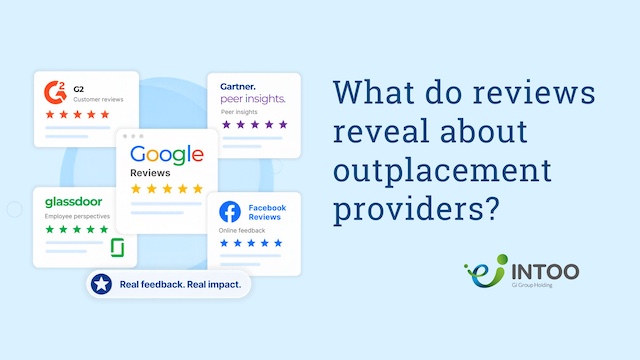
- Research reviews across multiple trusted platforms like SHRM, G2, Gartner, Google, Glassdoor, and SourceForge to identify consistent strengths, weaknesses, and service patterns.
- Look for providers who are praised for their personalized coaching, proactive support, strong communication, fast implementation, and scalable technology, while watching for repeated complaints about delays, inconsistent service, or poor support.
- The right outplacement provider can protect employer brand reputation, improve morale and retention among remaining employees, support departing employees compassionately, and help organizations navigate workforce changes more effectively.
Where to Research Outplacement Reviews
It’s easy to rely on testimonials from a vendor’s website because they’re positive and readily available. Still, it’s important to look at other sources to get a balanced view. Cross-reference reviews across multiple trusted third-party platforms, as each offers distinct perspectives on provider performance:
Society for Human Resource Management (SHRM), the voice of HR professionals, hosts reviews from practitioners in your field who understand both the emotional and logistical complexities of workforce transitions. These reviews tend to be practical and outcome-focused.
G2 focuses on software and service reviews, offering detailed ratings for usability, customer support, and overall value. G2 reviews often highlight how well the technology works, which is important since modern outplacement relies on digital platforms.
Gartner is known for thorough enterprise software reviews. If your company is big, these insights can be especially helpful.
SourceForge is usually focused on technical software, but its business service reviews add another perspective. These often mention integration features and system reliability.
Google reviews cover feedback from all kinds of organizations, big and small. While the quality of reviews can vary, looking for patterns can show real strengths and weaknesses.
Glassdoor works differently from the other platforms. Instead of customer reviews, it shows how vendors treat their own employees. This is important because checking a provider’s Glassdoor profile helps you learn about their culture and values, as well as how they care for their own people. If their staff feel respected and fulfilled, the provider is more likely to understand what employees need during transitions.
You’ll get the most insight by looking for patterns across these platforms, not by focusing on single scores or rankings. A provider might have a 4.9-star rating on their own site, but mixed reviews elsewhere. That difference tells you something important.
How to Read Outplacement Reviews Critically
Not all reviews should count the same. In general, a brief one-star review should carry less weight than a balanced review that thoughtfully reflects multiple aspects of the service.
Pay attention to reviews that share real experiences, like concrete results, specific program details, or clear descriptions of what happened. These reviews show how the service actually works, not just first impressions or a single, brief experience.
When you do see negative reviews, take a moment to see how the vendor responds. Do they accept real concerns, offer clear solutions, or get defensive? How a company handles criticism often says more about them than the complaint itself.
Also, pay attention to recurring themes rather than isolated complaints. A single review mentioning an issue may simply be a one-off experience, but if the same concern appears across multiple reviews and platforms, it’s more likely to reflect a broader pattern that could impact your experience as well.
High-quality reviews often include details such as, “The career coach provided actionable feedback on my LinkedIn profile and interview technique,” “Implementation was quick, allowing us to launch during the notice period,” or “The reporting dashboard gave us real-time visibility into participant involvement across regions.” These details indicate that the reviewer engaged actively with the service.
Positive Signs to Look for in Outplacement Reviews
The best outplacement providers get steady praise for two things: emotional support and real impact. These are the essential signs of a high-quality program.
Look for reviews that mention a good mix of coaching, technology, and support for employer communication. Outplacement services work best when they offer self-service tools, personal guidance, and open communication with HR teams.
The best providers earn recognition for characteristics that reveal partnership thinking:
- Proactiveness: Vendors who anticipate problems rather than waiting for complaints. “Our account manager reached out before launch day with a detailed implementation checklist.”
- Strong account teams: Rather than assigning accounts to rotating support staff, strong providers preserve consistent relationships. This continuity is extremely important during stressful transitions.
- Clear reporting: Detailed, consistent analytics across regions help you see how the program is used, what results people get, and where changes might be needed. Simple metrics can mask important nuances.
- Making things easier: Good providers handle communication, tech issues, and logistics, so your HR team has less to worry about.
If reviews mention these partnership qualities along with good results, such as positive feedback and high employee engagement, it shows the provider sees outplacement as an end-to-end service, not just a one-time event.

Red Flags to Watch for When Evaluating Reviews
A few negative reviews are normal and expected, even for the most popular companies. But if you see the same complaints mentioned in multiple reviews, it could mean there are larger problems that need a closer look.
Watch especially for patterns around:
- Implementation delays: If reviews mention slow setup, your service could be delayed. Outplacement should start quickly, ideally within days of the first notification.
- Inconsistent service quality: If reviews say quality varies by the person, coach, or location, it may indicate the provider can’t deliver consistent service. Consistency is important, especially when employees are going through tough times.
- Poor technology performance: If reviews mention crashes, slow systems, or confusing menus, the technology may not handle heavy use well or be designed for a wide variety of users.
- Unresponsive support: If many reviews say account teams are hard to reach or slow to fix problems, this is a serious concern.
- Limited flexibility: Some providers treat every client and employee the same way. If your company and its impacted employees have distinct needs, reviews that mention a lack of options or generalized career guidance should be a red flag.
- An overly sales-y approach: If a company’s focus is on the next sale rather than supporting your existing relationship, that may set you up for a tedious partnership.
Bad transition experiences can have long-term effects. Employees who feel unsupported might talk badly about your company, and those who stay may doubt your values. These reputation issues can last long after the transition is over.
Questions to Ask After Reading Outplacement Reviews
Reviews should help you ask better questions when evaluating vendors and guide you in confirming what you’ve learned from feedback.
During vendor demos and conversations, explore these details:
Measurement and outcomes: How is participant success measured? A combination of landing rates, time to land, and participant satisfaction can give you the clearest view of program effectiveness. A holistic look at these KPIs will give you a sense of how well the program caters to an individual’s goals. While most want to get right back into the job market, some seek retirement, entrepreneurship, or a return to school, while others may want to take time off before actively searching.
Industry and scale expertise: What industries and company sizes do you know best? Providers with real experience in your field understand your unique challenges. For example, tech layoffs are very different from those in manufacturing.
Implementation speed: How quickly can services be deployed during layoffs? Can notification and launch occur within 48 hours, or does their process require additional setup time?
Reporting depth: What reporting and analytics are available? Request sample dashboards. Can you track utilization by participant, service level, platform module, and region? Or does it lack filtering and give inconsistent reporting across location segments?
Coaching personalization: What level of customization does coaching offer? Are participants assigned coaches based on career background and needs, or do they receive generic guidance?
Coaching experience and tenure: How many years, on average, have the company’s coaches worked in career transition? How long have they been with the provider? What are their credentials?
Coaching availability: How often and for how long can an employee meet with a coach? Are there caps on the number of sessions or session durations? Is coaching restricted to weekdays? What communication modalities are available?
Technology currency: How often do they update their technology to keep up with trends and best practices? Do they have features like AI resume tools, interview practice tools, or networking and job-search resources for specific industries?
Response time standards: How fast does the account team reply to messages? Ask for clear service-level agreements (SLAs) rather than just hearing that they “focus on responsiveness.”
Referrals and proof: Can they share client references or success cases? Speak directly with recent clients about implementation experience and results.
Final Thoughts on Evaluating Outplacement Reviews
Choosing an outplacement provider should be a careful process, as this choice affects your company’s reputation and how you treat employees during tough times.
Reviews give you insight into five key areas:
- Coaching quality and accessibility: Whether guidance feels personalized or formulaic, and whether employees have to wait long periods to meet with a coach or have instant access.
- Participant experience: How supported employees feel during uncertain career transitions.
- Technology usability: Do the platforms make things easier or harder?
- Organizational responsiveness: How vendors treat you during crisis moments.
- Scalability and implementation support: Do the provider’s promises hold up when the service is actually rolled out?
Your evaluation process should synthesize insights across multiple platforms—SHRM, G2, Gartner, SourceForge, and Google—each providing distinct perspectives on provider performance and behavior. Look for repeating feedback patterns that surface across multiple reviewers and platforms. Seek specific results and detailed experiences. Examine how the vendors respond to criticism. Distinguish between isolated negative experiences and systemic operational weaknesses.
Most importantly, remember that good outplacement support leads to many positive results. Departing employees get real help that shows your company’s values. Those who stay see that the company cares about people, even in tough times. Your employer brand grows stronger as former employees share stories about how well they were treated. And your business runs more smoothly when transitions go well.
INTOO is a trusted partner to over 25,000 organizations, delivering personalized outplacement programs to individuals at every career level in every industry in 130+ countries around the world. See our reviews at the recommended sources above and read our testimonials and case studies to learn how we create meaningful impact to clients and job seekers. Contact us to find out how we can help your company manage workforce change.