
In our webinar, History Has its Eyes on You: Managing Organizational Change, Amy Waryas, EVP, Chief Human Resources Officer of the Boston Red Sox & Fenway Sports Management spoke about how her organization dealt with the challenges of the pandemic. When the 2020 Major League Baseball season was shortened due to COVID-19, difficult decisions had to be made. And the 2021 season required creative solutions to keep staff, players, and spectators safe and happy.
While the sports and entertainment industries had their own specific challenges, our conversation with Amy proved that the solutions can apply to almost any industry and organization experiencing change.
Here are some takeaways from that conversation that can help with managing organizational change.
Be creative
“…we’re trying like every HR person to think creatively about what to do about future flexibility. How do we become more progressive in an industry that typically isn’t necessarily as forward-thinking?”
Agility and creativity will provide your organization with the ability to more easily switch gears to meet challenges.
Align your perspectives
“What I found working for organizations that are really great places to work and really treat their employees like family—the employee perspective and the company perspective are really aligned, because they’re not going to make a short-term financial decision. Usually, they’re in it for the long haul.”
Aligning the employer and employee perspectives through transparency and clear communication results in dedication that goes both ways, increasing retention and engagement when change happens.
Live by your values
“I think that we treat our employees like family; it’s part of our values.”
Know your values as an organization and make sure you express them regularly, especially in times of change.
Consider the big picture
“We looked at our value of unity and having a unified workforce in the front office. And we decided to go the route of salary reductions where those that made the most had the biggest hit and those that didn’t make as much didn’t have a hit.”
When making difficult choices, look for solutions that could help to protect the business in the long term.
Treat employees well
“We’ve always had employee engagement in mind….We always make sure that we’re treating people well and treating their families well, keeping their needs in mind.”
Employees who are treated well stay engaged and remain loyal to your organization.
Think progressively
“I do think companies will lose people if they’re not progressive from a flexibility standpoint—even us.”
To retain talent, forward-thinking and flexibility is a necessity. For example, allowing flexible hours and options for remote work has quickly become the norm; companies refusing to adapt may lose out on top talent.
Get out of your comfort zone
“…when you see there’s a gap between what employees need and what leaders think, how do you bridge that gap? How can you get everyone outside their comfort zone a little bit? How do you convince people to try things and not be so scared of it?”
Change requires the willingness to try new ways of working. Are you attempting to return to pre-pandemic norms out of desire or necessity? Consider what worked during the pandemic and incorporate those changes for the long term—and continue to reap the benefits.
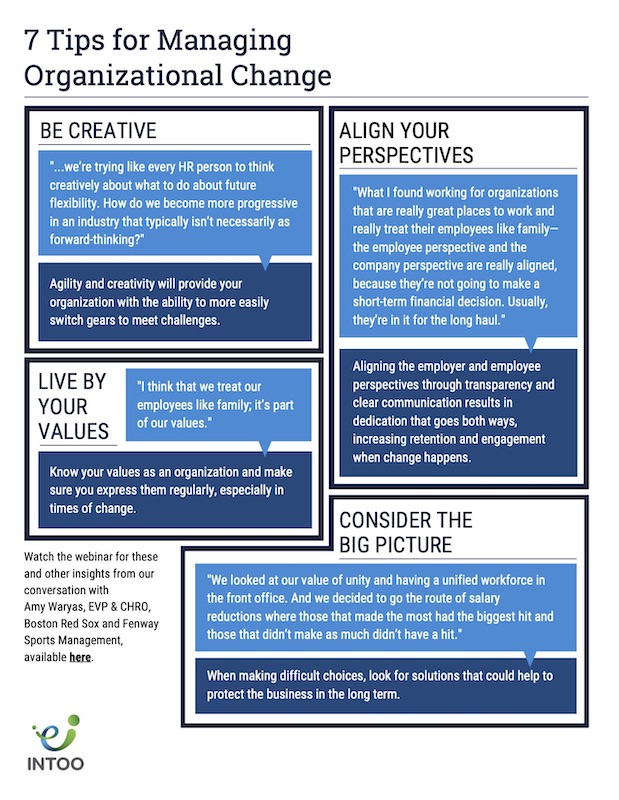
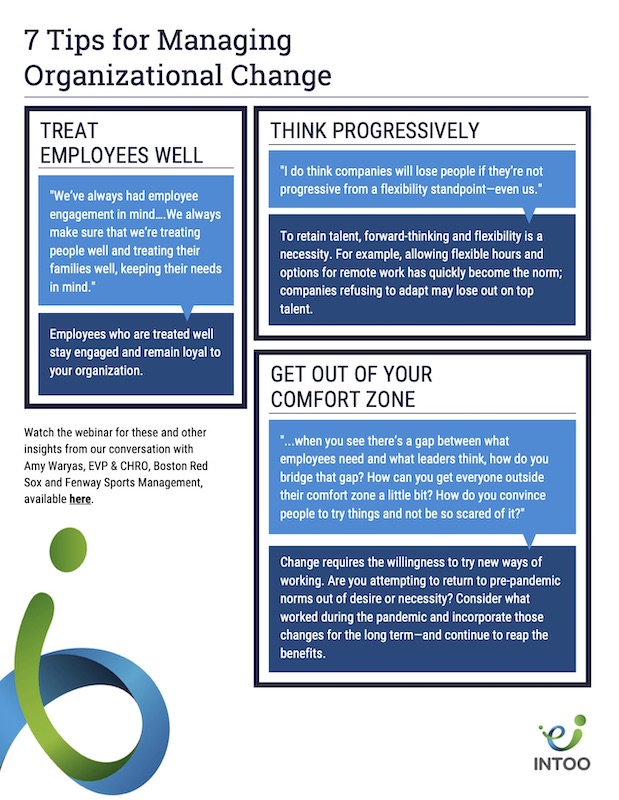
Download a printable version of these tips here.
Supporting Organizational Change
Managing organizational change effectively requires outside-the-box thinking, flexibility, and a willingness to try new approaches. Programs such as outplacement and internal mobility can be part of such approaches as they help your workforce transition to new employment and develop their careers within your organization respectively. When implementing change with careful consideration to your workforce and the future of your business, the policies and programs you put in place will reinforce loyalty to your organization as an employer and as a brand. INTOO is experienced in helping organizations of all sizes and in all industries through change and redundancy. For further advice and guidance, including planning for change, the redundancy process and employee support options available, contact us.
Robyn Kern is a seasoned business writer who has written in the HR, education, technology, and nonprofit spaces. She writes about topics including outplacement, layoffs, career development, internal mobility, candidate experience, succession planning, talent acquisition, and more, with the goal of surfacing workforce trends and educating the HR community on these key topics. Her work has been featured on hrforhr.org and trainingindustry.com.