The Workplace Innovation Paradox
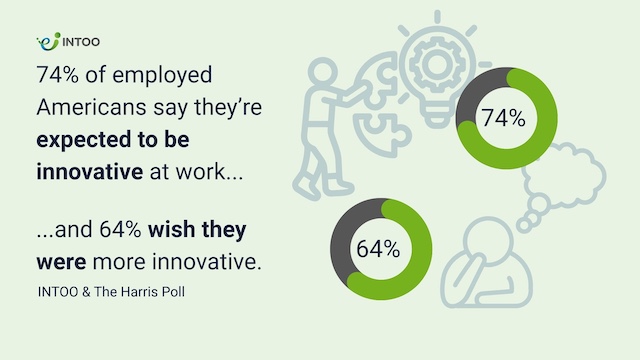
A new study from INTOO conducted by The Harris Poll found nearly three out of four full/part-time employed Americans (74%) say they are expected to bring new ideas to improve things at work, such as creative solutions, fresh strategies, and better processes. Workplace innovation isn’t optional anymore; it’s part of the job description.
Most employees are stepping up. 78% say they regularly bring new ideas to improve things at work.
Even so, nearly two-thirds (64%) wish they were more innovative at work.
In a culture that demands creativity, many employees feel they’re not doing enough.
There’s an aspiration gap—a voice saying, I should be pushing further.
At the same time, 30% don’t wish they were more innovative. This group may feel satisfied with their contributions or perhaps wary of the risks that come with pushing boundaries.
Because risk is where the story gets complicated.
The Fear Factor
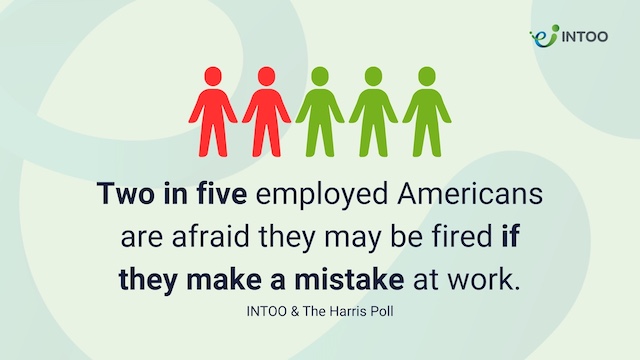
Two in five employed Americans (41%) are afraid that if they make a mistake at work, something as human as giving wrong information or forgetting to complete a task, it could result in being fired.
Let that sink in.
In a world demanding experimentation, 41% are worried that a mistake could cost them their job.
That fear isn’t abstract. It can live in the hesitation before speaking up in a meeting. In the decision to play it safe rather than propose something bold. In the second-guessing after hitting “send.”
And yet, when asked about their workplace culture, the majority paint a much more supportive picture:
- 79% say mistakes are typically treated as learning opportunities.
- 81% feel safe trying new things to improve business results.
- 82% would feel safe admitting they don’t know something at work, without worrying about being fired.
- 77% say their manager is always receptive to their new ideas.
So which is it? Fear or safety?
The answer is: both.
The Anxiety That Comes With Innovation Culture
The data exposes something powerful: structurally, many companies are creating the right conditions for organizational innovation.
Managers are receptive. Mistakes are framed as learning opportunities. Employees feel safe trying new strategies and admitting knowledge gaps.
And yet, the emotional undercurrent tells another story. A significant minority—nearly one in five (17%)—disagree that their manager is always receptive to their new ideas. And 41% fear termination for everyday mistakes like giving someone wrong information or forgetting to complete a task/completing incorrectly..
That gap between policy and perception is where innovation either thrives or stalls.
Psychological safety isn’t just about what leaders say. It’s about what employees believe will happen when something goes wrong.
Innovation as Career Currency for a New Generation
For younger and mid-career employees, innovation feels less like an option and more like a requirement.
Workers ages 18–44 are significantly more likely than those 65+ to say they regularly contribute innovative thinking at work (81% vs. 62%). And employees ages 35–44 are more likely than those 55+ to say their manager is receptive to new ideas (83% vs. 73%).
This suggests that newer generations see fresh thinking as part of how you prove your value. In fast-moving workplaces, innovation becomes career currency, or a way to demonstrate relevance and growth.
But it also raises an important leadership question: if older employees are less likely to feel their ideas are welcomed, is that perception or reality? And are organizations unintentionally equating innovation with youth?
If innovation is the expectation, leaders must ensure every generation feels equally heard and equally empowered to contribute.
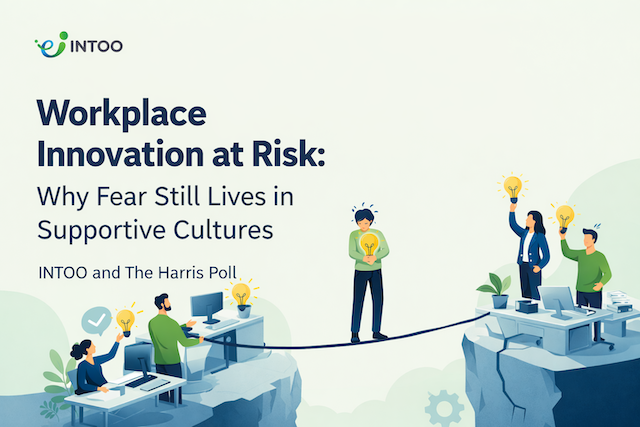
Walking the Innovation Tightrope
Many companies desire innovation.
But employees may be thinking: What if this backfires?
That’s the tightrope American workers are walking, where they are:
- Expected to innovate
- Regularly contribute ideas
- Wanting to do even more
- Feeling broadly safe
Yet 41% fear termination for mistakes.
Innovation doesn’t fail because employees lack ideas. It falters when fear coexists with expectation.
What This Means for Leaders
If you’re a senior leader or HR decision-maker, the takeaway isn’t that your culture is broken.
In fact, most employees report strong foundations for workplace innovation and psychological safety.
The opportunity lies in closing the innovation perception gap.
Ask yourself—at your organization:
- Do employees believe mistakes are learning opportunities, or just hear that they are?
- Do managers model vulnerability and admit their own knowledge gaps?
- Is feedback after failure framed constructively?
- Are there visible examples of people who tried something bold, failed, and thrived anyway?
Because organizational innovation isn’t driven by policy statements. It’s driven by lived experience.
The Future of Workplace Innovation Depends on Emotional Safety
American workers are ready to contribute. They’re bringing ideas. They want to bring more. They largely believe their managers are receptive.
But workplace innovation at scale requires more than permission; it requires deep, internalized safety.
When employees stop calculating the career risk of every idea, and when experimentation feels expected, not dangerous, that’s when creativity accelerates.
The question for today’s organizations is simple:
When your employees take that leap, do they feel like they’re flying—or falling?
Survey Method:
This survey was conducted online within the United States by The Harris Poll on behalf of INTOO from February 17-19, 2026 among 1,223 full/part-time employed adults ages 18 and older. The sampling precision of Harris online polls is measured by using a Bayesian credible interval. For this study, the sample data is accurate to within +/- 3.4 percentage points using a 95% confidence level.
For complete survey methodology, including weighting variables and subgroup sample sizes, please contact us.media@intoo.com.
Sarina Basch is VP of Marketing at INTOO, where she leads research on evolving workforce trends. She has led multiple high-impact studies—frequently cited by top-tier media—on layoffs, careers, and workplace innovation, helping inform how business leaders and HR executives navigate today’s employee experience.