
At a Glance: How Layoff Anxiety Has Changed
Layoff anxiety hasn’t faded since 2019 — it’s intensified and evolved.
Here’s what the Employee Mindset Report tells us:
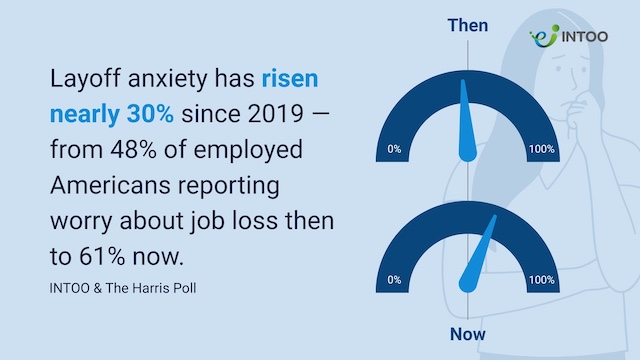
- Layoff anxiety has risen nearly 30% among employed Americans since 2019 (61% vs. 48%)
- Younger workers were the most anxious group in the 2019 study, and those ages 35–44 now report some of the highest anxiety levels
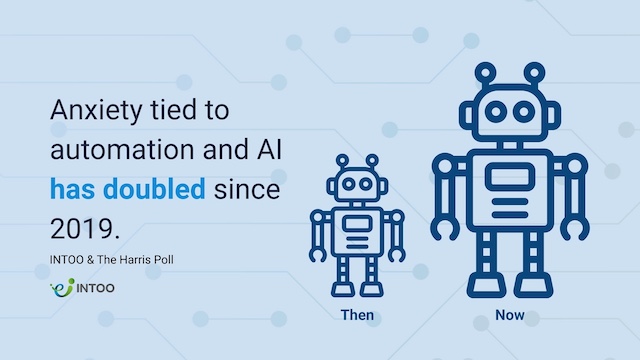
- Concerns about AI and automation have doubled since 2019
This post reviews key stats from both studies and examines some of the more recent layoff trends to show how employee sentiment around job security has shifted, and what employers can do now to respond.
When we first published 19 Fascinating Stats on Layoff Anxiety in 2019, the U.S. labor market was strong by many traditional measures. Yet even then, nearly half of employed Americans reported anxiety about losing their jobs.
Several years later, new research from INTOO and The Harris Poll shows that layoff anxiety has not only persisted but has also intensified, evolved, and expanded to new groups of workers.
Below are 19 key stats, combining insights from the original 2019 study with findings from INTOO’s most recent Employee Mindset Report, created in collaboration with The Harris Poll, to show how employee sentiment around job security has changed over time.
Layoff Anxiety: What Employees Told Us in the Past
- 48% of employed Americans reported experiencing layoff anxiety.
Even during a strong economy, nearly half of workers worried about job loss.
- 40% of employees had been laid off or terminated at least once in their career.
Past experience played a significant role in shaping fear about future job security.
- Fear of a recession was a top driver of anxiety.
Economic uncertainty loomed large in employee perceptions, even before major disruptions followed.
- Workplace rumors contributed heavily to anxiety.
Lack of clarity and informal communication amplified fear.
- Recent layoffs at an employee’s organization increased anxiety levels.
Seeing reductions firsthand made job loss feel more immediate and personal.
- Younger employees (ages 18–34) were more anxious than older workers.
Early-career employees felt especially vulnerable.
- Nearly half of employees said they did not feel prepared for a layoff.
Despite widespread anxiety, many workers felt ill-equipped to respond if it happened.
- Employees with fewer financial or professional safety nets felt the least prepared.
Renters, parents, and those without college degrees reported higher vulnerability.
- Layoff anxiety existed even when unemployment was low.
The data suggested anxiety was not just cyclical. Rather, it was cultural.
What the Most Recent Research Reveals
- More than 60% of employed Americans now report experiencing layoff anxiety.
What affected nearly half the workforce in 2019 now affects a clear majority.
- Layoff anxiety has increased by nearly 30% since 2019.
This sharp rise signals a structural shift in how employees perceive job stability.
- The current economy is now the leading driver of layoff anxiety.
Economic volatility remains central to employee concern.
- Anxiety tied to automation has doubled since 2019.
Technology-driven disruption is now a major source of fear.
- Fear of a potential recession driving layoffs has grown significantly since the last study.
Recession anxiety has increased by nearly 40% compared to 2019 levels.
- Employees ages 35–44 now emerge as one of the most anxious groups.
Workers in this age range, who often have greater financial and leadership responsibilities, feel increasingly vulnerable.
- Employees ages 35–44 are more than twice as likely as older workers to cite automation as a driver of anxiety.
This highlights concern about long-term career relevance, not just short-term layoffs.
- 76% of employees believe most recent layoffs could have been avoided with better leadership decisions.
Perceived management effectiveness is now tightly linked to employee trust.
- 69% of employees agree that “AI layoffs” are often an excuse for cost-cutting.
Skepticism around automation-related messaging is widespread.
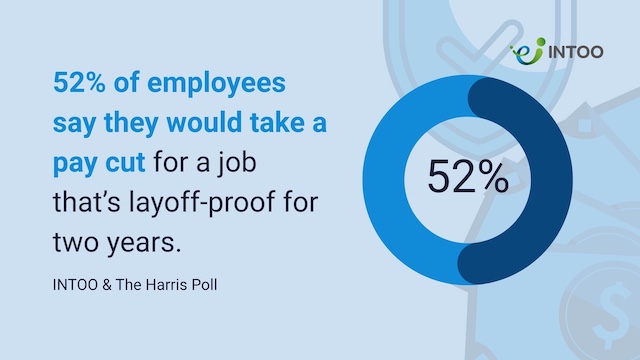
- 52% of employees say they would take a pay cut for a job that is “layoff-proof” for two years.
Job security has become a competitive differentiator—sometimes even more valuable than compensation.

What These 19 Stats Tell Us
Looking at these findings side by side reveals a clear trajectory:
- Layoff anxiety has grown from a significant concern to a dominant workforce sentiment
- The drivers have shifted from short-term recession fears to long-term structural uncertainty
- Anxiety now affects mid-career and higher-income workers as much as (or more than) early-career employees
- Trust in leadership and corporate messaging has become a critical factor
In short, employees are no longer reacting to isolated events. They are responding to patterns.
Why This Matters for Employers
Layoff anxiety influences employee engagement, retention, productivity, and employer brand, whether layoffs actually occur or not.
Organizations that want to compete for talent must now:
- Communicate with greater transparency and consistency
- Clearly explain how automation and AI fit into long-term workforce plans
- Invest in internal mobility, reskilling, and career pathways
- Treat job security and predictability as part of the employee value proposition
👉 To explore the full data and insights behind these findings, download INTOO’s most recent Employee Mindset Report.
Actionable Takeaways for Employers
Now that layoff anxiety has shifted from a situational concern to a persistent workforce reality, addressing it requires more than reassurance; it requires strategy.
Here’s how employers can respond.
1. Treat layoff anxiety as a leading indicator, not a morale issue
With more than 60% of employees experiencing layoff anxiety, fear is no longer limited to moments of disruption. Rising anxiety levels should be monitored the same way organizations track engagement or retention risk.
Action:
- Include questions about job security and confidence in leadership in engagement or pulse surveys
- Track changes over time, especially following business updates, technology announcements, or leadership transitions
2. Communicate early, clearly, and consistently
Employees are filling information gaps themselves, often through rumors or social media, when they believe the information they’ve received through official channels isn’t transparent. The data shows a growing trust gap between employees and leadership around layoff decisions.
Action:
- Proactively share how company performance, industry demands, and other factors affect the workforce, instead of waiting for moments of crisis
- Explain why decisions are being made, not just what is happening
- Equip managers with clear talking points so employees hear consistent messages at every level

3. Be explicit about how automation and AI affect jobs
Automation anxiety has doubled since the original study, and many employees believe “AI layoffs” are simply disguised cost-cutting. Vague innovation messaging can increase fear rather than reduce it.
Action:
- Clearly outline which roles may change, which are expected to grow, and where skills will evolve
- Pair automation announcements with visible investments in reskilling and upskilling
- Highlight internal examples of employees successfully transitioning into new roles
4. Pay special attention to employees ages 35-44
Workers in this age range now report some of the highest levels of layoff anxiety. Since they often hold critical institutional knowledge and leadership-track roles, their concern should not be ignored.
Action:
- Offer career pathing conversations tailored to all employees, and especially those in the 35–44 age range
- Provide internal mobility options that allow lateral movement, not just upward promotion
- Train managers to recognize and address anxiety among experienced employees, not just early-career talent
5. Recognize that job security is a competitive advantage
More than half of employees say they would trade pay for stability. That makes predictability a powerful differentiator in attracting and retaining talent.
Action:
- Be transparent about what stability will look like over the next 12–24 months
- Emphasize internal opportunities, redeployment programs, and long-term employability
- Position career development as part of your employer brand, not just a contingency plan
6. Prepare for layoffs humanely, even if you hope to avoid them
The data shows employees remember how layoffs are handled and believe many could be better managed. Poorly executed reductions damage trust long after the event.
Action:
- Establish clear, fair layoff processes before they’re needed
- Communicate criteria and methods transparently
- Provide strong outplacement and career transition support to affected employees, and communicate that support clearly to those who remain
7. Help employees feel prepared, not helpless
Layoff anxiety is amplified when employees feel unprepared for change. Preparedness doesn’t encourage turnover; it builds trust.
Action:
- Offer career resilience resources such as skills assessments, coaching, and development planning
- Normalize career conversations that include long-term employability, not just current roles
- Reinforce that supporting employee careers is part of responsible leadership
Bottom Line
The difference between the 2019 findings isn’t only in the pervasiveness of layoff anxiety, but also in its constancy. Today’s data reflects that this anxiety is now embedded in how employees experience work.
Organizations that acknowledge this reality, communicate transparently, and invest in employee growth will be better positioned to retain talent, protect trust, and build resilience in an evolving world of work.
👉 Download INTOO’s most recent Employee Mindset Report to explore the full data and insights.
Layoff anxiety doesn’t just affect employees who leave; it shapes how remaining employees view leadership, stability, and the future of work. INTOO helps employers navigate these moments with confidence through award-winning outplacement and career development programs that prioritize well-being, dignity, and long-term employability. From supporting impacted employees during transitions to strengthening career resilience and internal mobility for current teams, INTOO partners with organizations to protect their people and their employer brand. To learn more about how INTOO can support your workforce strategy, get in touch with us here.